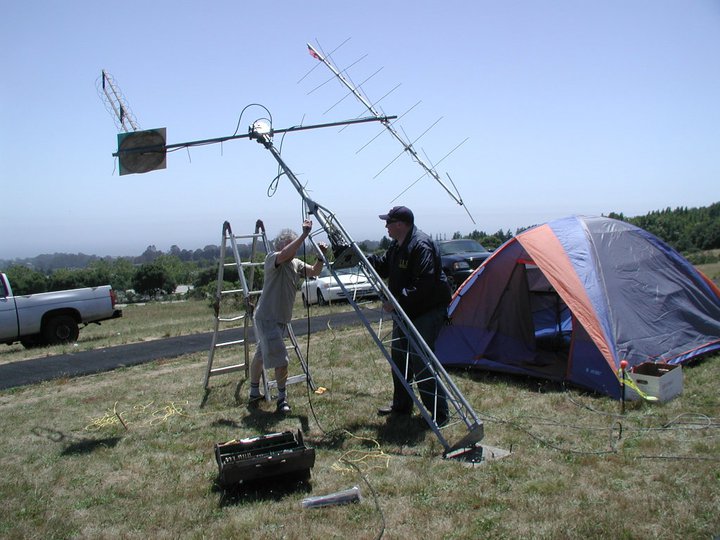
Helping Steve (AC6P) raise his satellite rig antenna at UCSC’s 2011 Field Day site.
I’ve been interested in amateur radio for a few years now, mainly due to my job. I’m a professional emergency manager and firefighter, and have worked closely with our local ARES and RACES volunteers in that capacity. Plus, I’ve always been something of a tech geek and grew up with a long-time ham for a grandfather.
My career started in the health, safety and environmental (HSE) world, though always with an aspect of emergency preparedness. I graduated from the University of Southern California with a degree in Safety and Health in 1997 and started out working for one of my professors who ran a consulting firm – we worked primarily on risk management and process safety programs for clients using highly hazardous chemicals such as chlorine, ammonia, acids and other chemicals. After that, I went to work for the Los Angeles Times running the safety aspect of their HSE program. This included emergency planning and fire/life safety for the main offices, three printing plants and various other satellite facilities. I also had my first exposure to EMS during this job when I was tasked with setting up a medical emergency response team when the in-house medical department was closed. We trained about 40 security guards and other response team personnel as first responders to deal with workplace injuries.

ConocoPhillips fire school at UNR-Elko in 2003. I’m in the upper right corner in the darker blue shirt.
After the Times, I went to work for Tosco as a training specialist for health, safety and environmental compliance for the company’s West Coast pipeline and terminal operations. Tosco had purchased Unocal’s refining and marketing assets (including the 76 gasoline brand) in the late 1990s, so most of our operations were out here. Initially, I supported 11 refined petroleum product terminals in California, Arizona, Oregon, Washington and Hawaii and several hundred miles of crude oil and refined product pipelines in California. On my third day with Tosco it was announced that Phillips Petroleum would be purchasing Tosco and shortly after that merger closed, Phillips merged with Conoco to form ConocoPhillips, which at that time was the 5th or 6th largest energy company in the world. My responsibilities expanded with the mergers from those original 5 states to cover 1,200 employees in 33 states. I was also selected as one of the five safety officers to serve on the corporate Americas Incident Management Assistance Team (IMAT) which served as the incident management team for major incidents throughout North and South America. While I loved working for ConocoPhillips, the travel requirements were pretty onerous and with our daughter on the way, I decided to take another consulting job working with an insurance broker who provided loss control services to public schools, community colleges and municipal governments. It was during this time that I started reassessing where I wanted my career to go and two events helped me decide that.
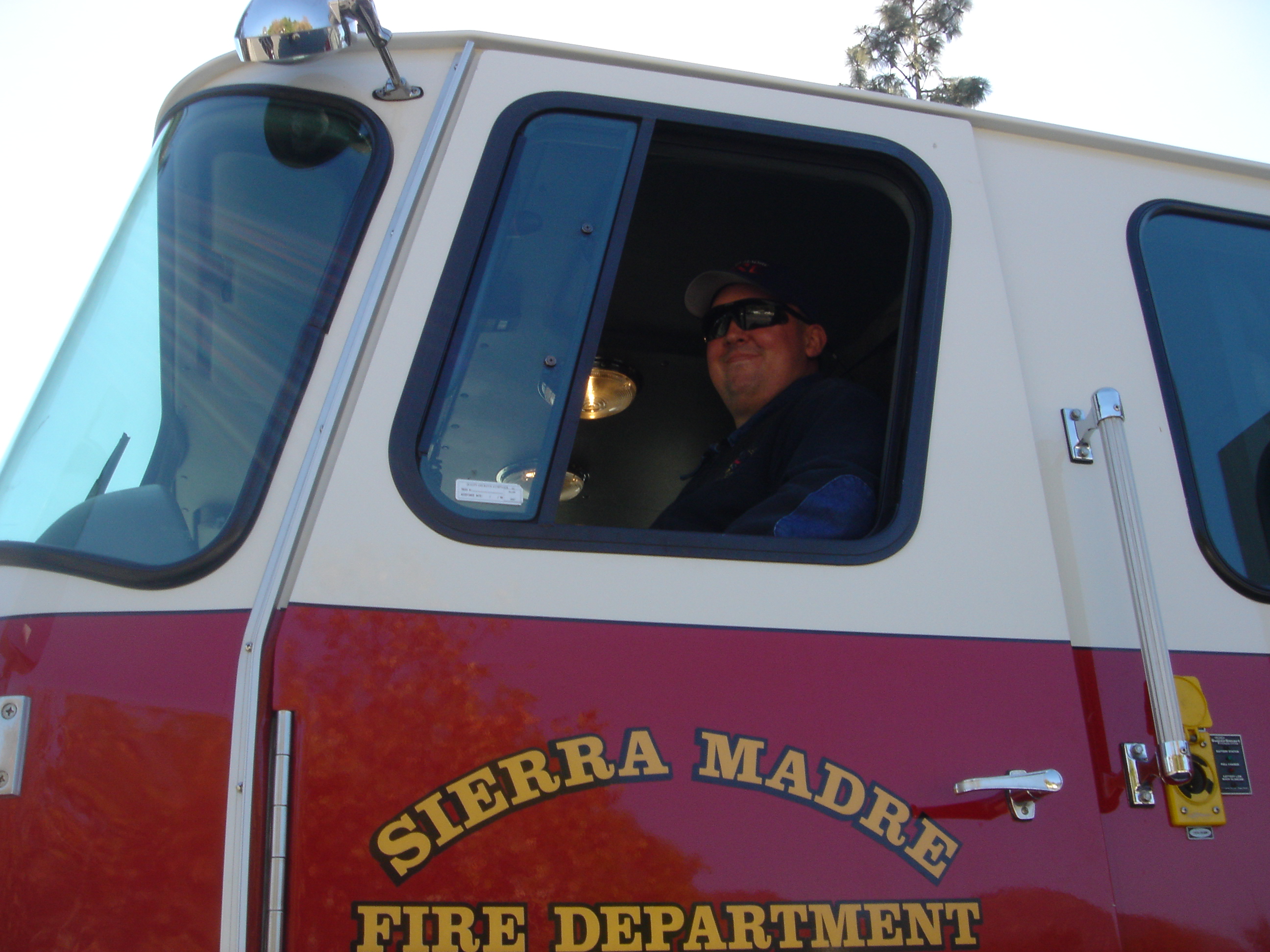
Driving SMFD Engine 41 in 2005.
In 2003, I joined the volunteer fire department in Sierra Madre, California where my wife and I were living. I grew up next door to a Pasadena firefighter and had always been fascinated by the fire service. I had briefly considered trying to make a career of it when I was a student at USC, but after watching a couple friends struggle to get hired I decided a private industry career was probably more realistic. However, when the opportunity to be a volunteer came up, I jumped at it. I had completed EMT training and a 40 hour petrochemical firefighting school while working for ConocoPhillips, so I had some basic skills when I began the process of joining SMFD. I was voted on as a Trainee in June 2003 and became a Firefighter in December (just a couple weeks after our daughter was born). At the time, Sierra Madre ran an all-volunteer department covering 11,000 residents with a call volume of about 750 per year. Because I worked from home during my time on the department, I was one of the few daytime responders and responded to about 50% of all calls each year. I spent a lot of time staffing the ambulance early on as well as working on both the engines and truck. In 2005, I started training as an Engineer and worked in an acting capacity some before I was promoted in 2006.
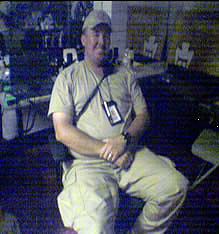
In the DMAT CA-1 command post during Hurricane Katrina response in 2005.
While I was with SMFD, I also decided to join Disaster Medical Assistance Team (DMAT) CA-1 in 2005. DMATs are federal response teams which provide medical support during disasters – they operate field hospitals, augment existing medical facility staff and assist with evacuations of ill, injured and special needs victims during major disasters. At the time, I was co-teaching Red Cross first responder classes with the Deputy Commander of CA-1, and he convinced me to join as a Safety Officer. Within a few months of joining the team, Hurricane Katrina hit and we deployed to Biloxi, Mississippi for two weeks. This was my first time dealing directly with a Presidentially-declared disaster, and I came home from the deployment knowing that I wanted to make public safety and emergency management my primary career.
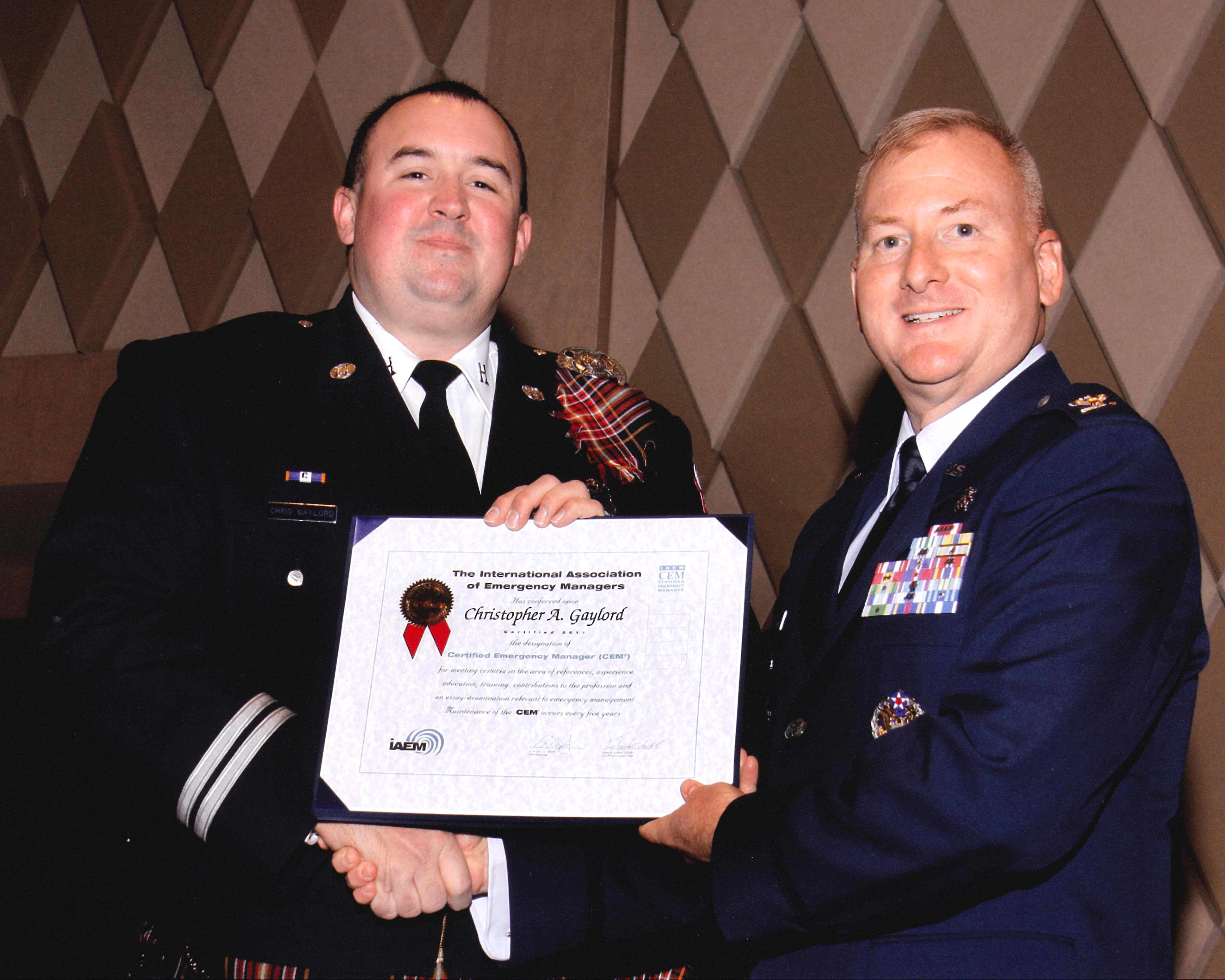
Receiving my Certified Emergency Manager certificate from Col. Thomas Greenlee, USAF in 2011.
It took a couple years, but in April 2007 I was hired as the Campus Emergency Manager at the University of California Santa Cruz. I was the first full-time emergency manager hired by the campus, so I had the opportunity to build the program in many ways. Additionally, UCSC operates its own Fire Department and my position is a staff Captain on the department. In many ways, this made the job perfects for me as I was able to apply both my private industry emergency planning experience and my fire service experience to the job. My wife, daughter and I relocated from Southern California to the Santa Cruz Mountains and have been very happy there.
My interest in amateur radio largely stems from these experiences. I’m very interested in emergency communications and see that as one of the most important missions of amateur radio. Probably due to my experience with mobile and portable radio systems in the fire service, I’m also interested in mobile ham operations and plan to set up a mobile VHF and HF system once I buy a new vehicle this summer or fall. I’m also very interested in the tactical aspects of APRS including weather stations and want to explore that as well.
73.
 W6YTB
W6YTB 